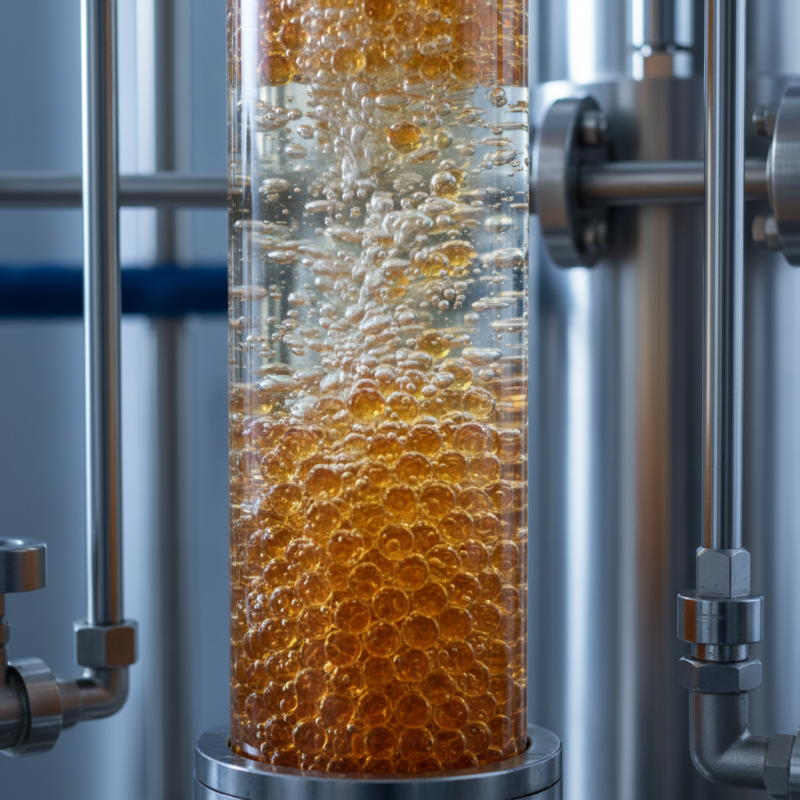
What is a Strong Base Anion Resin and How is it Used?
strong base anion resin plays a vital role in water treatment and purification. This type of resin is known for its high capacity to remove negatively charged ions. It operates through an ion exchange process, facilitated by strong alkaline groups.
In industrial applications, strong base anion resin is often used in deionization systems. It helps in removing impurities from water, which is crucial for various sectors. For example, power plants and pharmaceutical industries rely on this technology to ensure product quality.
Despite its effectiveness, there are challenges in using strong base anion resin. Regeneration can be complex and costly. Additionally, users may find that not all resins perform equally well. Continuous research and development are necessary to improve the performance of these resins.
What Defines a Strong Base Anion Resin in Water Treatment?
Strong base anion resins play a vital role in water treatment. These resins are essential for purifying water by removing unwanted anions. They trap substances like nitrates, sulfates, and phosphates. This capability makes them a preferred choice in municipal and industrial applications.
The defining feature of a strong base anion resin is its high capacity for ion exchange. They operate efficiently across various pH ranges. When water passes through these resins, anions are exchanged for hydroxide ions. The process transforms contaminants into harmless compounds. The design of these resins often includes a highly cross-linked structure, enhancing stability and performance.
However, not all anion resins are equal. Some may become saturated quickly, leading to a decrease in efficiency. Proper maintenance is crucial to maximize performance. Regular regeneration of these resins is often necessary to ensure longevity. Users may struggle with understanding the best practices for regeneration and maintenance, highlighting a gap in knowledge. The effectiveness of strong base anion resins relies heavily on user understanding and application.
Key Chemical Properties and Structure of Strong Base Anion Resins
Strong base anion resins are a special type of ion exchange resin. They are commonly used in various water treatment processes. Their structure typically includes quaternary ammonium groups. These functional groups are essential for their ability to exchange anions effectively.
In practical applications, strong base anion resins demonstrate significant selectivity for specific anions like chloride, sulfate, and nitrate. A typical study revealed that in certain environments, these resins can remove over 95% of targeted anions. This high efficiency is crucial for industries such as pharmaceuticals and food processing. Yet, their performance can vary based on the resin's age and operational conditions.
The inability of some resins to perform under extreme pH conditions can be a concern. Research indicates degradation at both very low and very high pH levels, which reduces lifespan. Additionally, improper regeneration can lead to lower ion exchange capacity over time. Thus, monitoring these parameters is vital to optimizing their use in industrial settings.
Common Applications of Strong Base Anion Resins in Industrial Processes
Strong base anion resins play a crucial role in various industrial processes. These resins are vital for the treatment of water and wastewater. They effectively remove anions like chlorides, nitrates, and sulfates from solutions. Studies show that well-designed systems using strong base anion resins can achieve over 95% removal efficiency.
In the power generation industry, strong base anion resins are often utilized during the demineralization process. This helps in producing high-quality ultrapure water. The need for high purity levels is increasing. Data indicates that demand for ultrapure water in power plants may rise by 20% in the next five years. However, the performance of these resins can degrade over time, requiring careful monitoring.
Moreover, in pharmaceutical production, strong base anion resins extract contaminants that could affect drug purity. Specific reports suggest that using these resins can lower impurities by over 50%. Yet, there are challenges. Not all resins perform equally. Some may need frequent regeneration, leading to increased operational costs. Industries must assess these factors to optimize their use effectively.
Common Applications of Strong Base Anion Resins in Industrial Processes
Comparison of Strong Base vs. Weak Base Anion Resins in Purification
Strong base anion resins play a crucial role in water purification. They effectively remove anions, such as sulfates and nitrates, from water. These resins are often used in industrial applications where high purity water is essential. Their ability to operate at various pH levels makes them versatile.
In contrast, weak base anion resins react differently. They target a narrower range of anion removal. While they can selectively remove certain substances, they may not be as effective as strong base resins for broader purification needs. When considering efficiency, strong base resins often outperform weak base alternatives.
However, weak base resins have their advantages. They can be more cost-effective and useful in certain scenarios. A user might find that weak base resins, with their slower kinetics, require less frequent regeneration. This can be both a drawback and an opportunity for efficiency. Ultimately, the choice of anion resin depends on the specific application and desired water quality. Each type presents unique challenges worth contemplating.
Performance Metrics: Regeneration and Longevity of Anion Resins
Strong base anion resins play a crucial role in water treatment processes. Their ability to remove anions, such as nitrates and sulfates, makes them essential. However, evaluating their performance metrics, especially regeneration and longevity, is vital for effective use.
Regeneration is how these resins restore their ion-exchanging capacity. A common method involves treating the resin with a concentrated salt solution. This process replaces the accumulated anions with hydroxide ions. However, the effectiveness of regeneration can vary. Poor regeneration may lead to decreased efficiency over time. Some users might overlook specific conditions that affect performance. For instance, water quality impacts resin longevity.
Longevity is another key factor. Anion resins can last several years, but their lifespan varies. Factors like temperature and pH levels influence degradation. Harsh conditions may reduce effectiveness significantly. Regular monitoring is essential but often neglected. Users should reflect on their practices to ensure optimal performance of these resins. Keeping track of performance metrics helps in maintaining the resin's longevity and efficiency.
What is a Strong Base Anion Resin and How is it Used? - Performance Metrics: Regeneration and Longevity of Anion Resins
| Parameter | Value | Unit | Remarks |
| Exchange Capacity | 1.5 | meq/g | Typical for strong base anion resins |
| Operating pH Range | 0 - 14 | - | Wide range for various applications |
| Regeneration Frequency | 20-30 | cycles/year | Depends on water conditions |
| Longevity | 5 - 10 | years | Depends on operating conditions |
| Temperature Stability | < 60 | °C | Above this may cause degradation |
| Max Flow Rate | 10 | BV/h (Bed Volume per hour) | Optimal for performance |